
Reviewed by Dr. Samar Fadavi, DDS
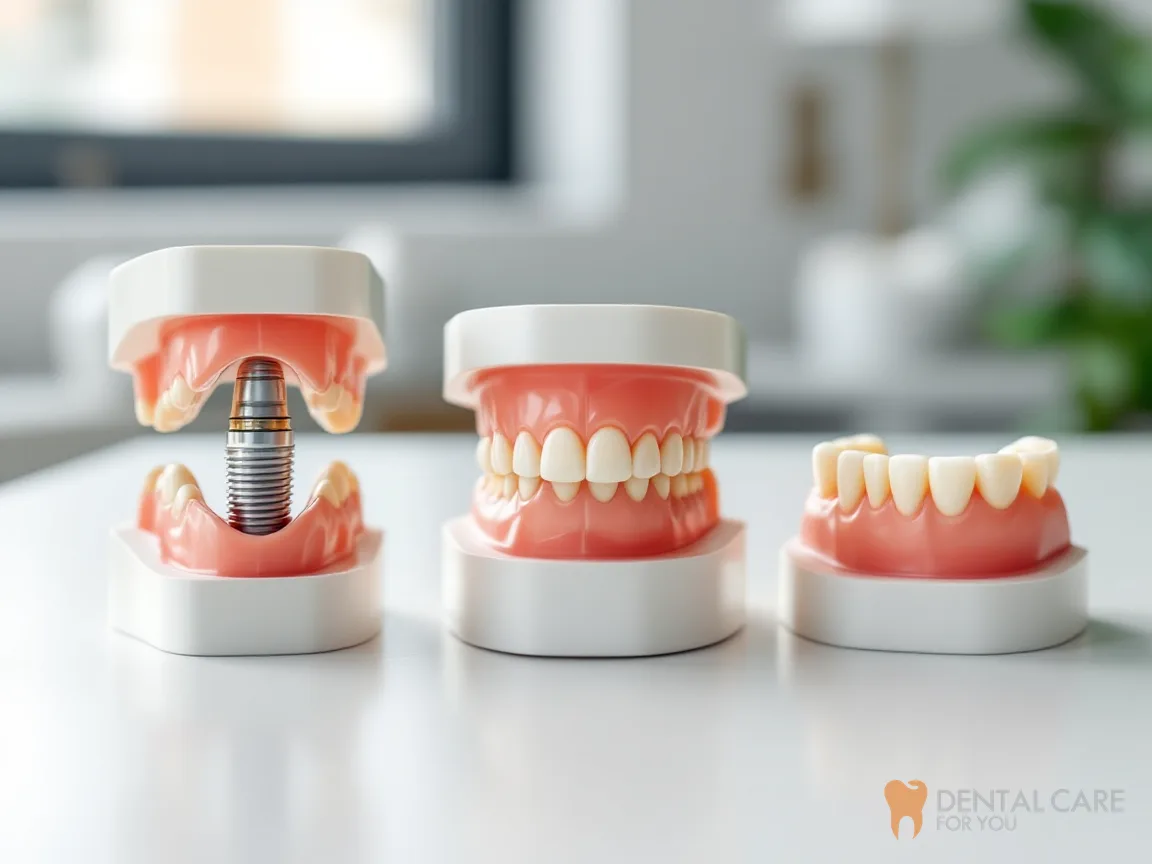
Short answer: Implants, bridges and dentures all replace missing teeth, but they work differently. An implant replaces the root and stands on its own. A bridge uses the teeth beside the gap for support. A denture is removable and can replace a few teeth or a full arch. The right choice depends on your bone, gums, neighbouring teeth, health, goals and coverage.
Why replacing a missing tooth matters
A missing tooth is more than a gap in your smile. Over time, the teeth beside the space can tilt into it, and the tooth above or below can drift out of place. Your bite can change, food can trap more easily and chewing can shift to one side. The jawbone where the tooth used to be also slowly shrinks because there is no root to stimulate it.
The good news is that there are several reliable ways to replace teeth. This guide compares the three main options, implants, bridges and dentures, so you can go into your dental visit with clear questions. It is general information for patients in Scarborough, the Danforth and East Toronto. Your dentist will recommend what suits your mouth after an exam and imaging.
Option 1: dental implants
An implant is a small post placed in the jawbone. After it bonds with the bone over a few months, a crown, bridge or denture is attached on top. Our dental implants page explains treatment in detail.
What implants do well
- They stand on their own and do not rely on neighbouring teeth.
- They help keep the jawbone in place where the tooth was lost.
- They feel stable when chewing and speaking.
- They are cleaned much like natural teeth.
- They can also hold a bridge or a denture firmly in place.
Things to consider
- Treatment involves minor surgery and a healing period, often several months in total.
- You need enough healthy bone, or a graft first.
- Gum disease must be treated before surgery.
- Smoking and some health conditions or medicines can affect healing.
- Insurance coverage varies widely.
Option 2: dental bridges
A fixed bridge replaces one or more missing teeth by joining a false tooth to crowns placed on the teeth on each side of the gap. The bridge is cemented in place and does not come out. Our crowns and bridges page explains how bridges are made.
What bridges do well
- Treatment is usually faster than implants, often two or three visits.
- No surgery is needed.
- They are fixed in place and feel stable.
- They can be a good choice when the teeth beside the gap already need crowns.
Things to consider
- The teeth beside the gap are shaped to hold the crowns, which removes healthy tooth structure if those teeth were sound.
- Cleaning under the false tooth needs floss threaders or special brushes.
- The supporting teeth can still decay at the edges.
- A bridge does not stop bone loss under the missing tooth.
- If a supporting tooth fails, the whole bridge may need to be redone.
Option 3: dentures
A denture is a removable appliance with artificial teeth set in a gum-coloured base. A partial denture replaces some teeth and clips to the remaining natural teeth. A complete denture replaces all the teeth in an arch. Our guide to dentures explains types, fit and daily care.
What dentures do well
- They can replace many teeth at once.
- Treatment usually involves no surgery.
- They can often be made relatively quickly.
- Teeth can sometimes be added to a partial denture if more teeth are lost later.
- They are often well covered by insurance and may be covered by the Canadian Dental Care Plan for eligible patients.
Things to consider
- They are removed for cleaning and usually at night.
- They can feel bulky at first and take time to get used to.
- Lower complete dentures in particular can feel loose.
- The jawbone continues to shrink, so dentures need relining and eventually replacing.
- Chewing force is lower than with natural teeth or implants.
Option 4: implant-supported dentures
For people missing all or most of their teeth, a combination is often possible. Two or more implants can hold a denture firmly in place. Some designs snap on and off for cleaning. Others are fixed and removed only by the dentist. This option gives many denture wearers far more stability, especially in the lower jaw, while needing fewer implants than replacing every tooth one by one.
Comparing the options side by side
Effect on neighbouring teeth
Implants leave the neighbouring teeth untouched. Bridges need crowns on the teeth beside the gap. Partial dentures rest on and clip to nearby teeth, which can put some extra load on them.
Effect on the jawbone
Implants help keep bone in the area. Bridges and dentures do not replace the root, so bone continues to shrink slowly over time.
Treatment time
Dentures and bridges can often be completed in weeks. Implants usually take several months because the bone needs time to bond with the implant, and longer if grafting is needed.
Daily care
Implants are brushed and flossed like teeth. Bridges need cleaning under the false tooth. Dentures are removed, brushed and soaked, and the gums are cleaned too.
Comfort and confidence
Fixed options, implants and bridges, feel more like natural teeth. Removable dentures take adjustment, but many people wear them comfortably for years, and implants can make them far more stable.
Coverage
Dentures and bridges are covered by many insurance plans. Implant coverage varies more. CDCP coverage depends on the service and the plan rules. Our guide on what affects the cost of dental implants explains the factors behind an implant plan.
Questions that help you choose
- How many teeth are missing, and where? One front tooth, one back molar and a full arch each point to different options.
- Are the teeth beside the gap healthy? If they are sound, an implant avoids shaping them. If they already need crowns, a bridge may make sense.
- Is there enough bone? CBCT 3D imaging shows whether an implant is possible without grafting.
- What is your general health? Diabetes, smoking, some medicines and recent radiation therapy can affect implant healing.
- How do you feel about removable teeth? Some people do not mind taking teeth out at night. Others strongly prefer fixed teeth.
- What is your timeline? A wedding, a trip or a job interview may affect what is possible.
- What does your coverage include? Ask for a predetermination so you can compare options with clear numbers in writing.
Choices for older adults
Many seniors in Scarborough and East York already wear dentures or have lost several teeth over the years. Age alone is not a barrier to implants. What matters more is general health, bone, medicines and the ability to clean around the teeth. For some older adults, a well-made denture or an implant-held denture is the most practical choice. For others with limited hand strength, a simpler design is easier to keep clean. Our dental care for seniors page explains how we plan treatment for older patients, and our guide on aging and dental health covers changes that come with age.
Temporary options while you decide
If you lose a tooth suddenly, you do not have to make a final decision that day. A temporary option, such as a simple removable partial denture, can fill the space while the area heals and you consider your choices. This is common after an extraction, when the gum and bone need time to settle before an implant or bridge is made.
What to avoid
- Do not leave a gap for years without advice. Teeth can shift and bone can shrink, which narrows your options later.
- Do not choose based on one factor alone. Weigh health, comfort, care and coverage together.
- Do not ignore gum disease. It affects every option, and it must be treated before implants.
- Do not wear a poorly fitting denture for long. It can cause sores and speed up bone loss.
- Do not skip check-ups after treatment. Bridges, dentures and implants all need regular checks.
Steps to plan your replacement
- Book an exam to check the gap, the teeth around it and your gums.
- Have x-rays and, where useful, CBCT 3D imaging to assess the bone.
- Ask the dentist to explain every suitable option, including doing nothing for now.
- Get a written estimate for each option you are considering.
- Check your insurance or CDCP coverage through a predetermination.
- Decide with your dentist, then plan the timing of each step.
Front teeth and back teeth
Where the missing tooth sits often shapes the choice. A front tooth is seen every time you smile and speak, so appearance, gum shape and colour matching matter most. An implant can look very natural in the front of the mouth when there is enough bone and healthy gum, while a bridge can also give a good result when the neighbouring teeth already need crowns. A small removable partial denture is sometimes used as a temporary front tooth while you decide.
Back teeth do most of the chewing. Here, strength and stability matter more than appearance. A missing molar left unreplaced can let the teeth above and beside it drift, which affects the whole bite. Implants and bridges both handle chewing forces well. A partial denture can also replace several back teeth on both sides of the mouth at once.
Living with each option day to day
Eating
Implants and bridges let most people eat a normal diet once treatment is complete. Denture wearers usually start with soft foods cut into small pieces and slowly add firmer foods as they get used to chewing with the denture. Very sticky or hard foods are harder with dentures.
Speaking
Fixed teeth rarely affect speech. New dentures can change how some words sound for the first few weeks. Reading aloud at home helps the tongue and lips adjust faster.
Cleaning
Implants need brushing and cleaning around the gum line. Bridges need a floss threader or small brush under the false tooth each day. Dentures are taken out, brushed with a denture brush and kept moist overnight, and the gums and any natural teeth are brushed too.
Check-ups
Every option needs regular visits. The dentist checks the gums, the supporting teeth, the fit of dentures and the bone around implants, and catches small problems before they grow.
When to see a dentist
Book a visit if:
- You have recently lost a tooth or been told a tooth cannot be saved.
- Your denture is loose, sore or broken.
- A bridge feels loose or the gum under it is sore or bleeding.
- Teeth beside a gap are tilting or food keeps getting stuck.
Our dental implants and crowns and bridges pages explain treatment at our Danforth Avenue clinic.
Questions about choosing a tooth replacement
Which option lasts longest?
All three can serve you well for many years with good care. Implants do not decay, but the gum around them needs care. Bridges depend on the health of the supporting teeth. Dentures need relining as the jaw changes.
Am I too old for implants?
Age alone is rarely the issue. General health, bone, medicines and the ability to clean around implants matter more.
Can I switch from a denture to implants later?
Often yes. Many denture wearers later add implants to hold their denture more firmly. Bone loss over time can affect what is possible, so ask early.
Does a bridge damage the teeth beside it?
The teeth beside the gap are shaped for crowns, which removes some structure. If those teeth already have large fillings, this may be a reasonable trade.
Which option is covered by CDCP?
CDCP coverage depends on the service and plan rules. Dentures are generally more likely to be covered than implants. Bring your CDCP details and we will explain.
How soon after an extraction can I replace the tooth?
It depends on healing and the option chosen. A temporary denture can fill the space while the area heals before an implant or bridge.
Do I have to replace a missing back tooth?
Not always, but leaving a gap can let nearby teeth drift and change your bite over time. Ask the dentist how your bite is likely to change before deciding to leave it.
Missing a tooth? Call Dental Care For You at (647) 350-4500 or send us a message. We will explain every option that suits your mouth and give you a written estimate for each.
About this guide
Prepared by the team at Dental Care For You, 3520 Danforth Ave, Unit 107, Scarborough, ON M1L 1E5. Phone (647) 350-4500.